Choose PostgreSQL sslmode without disabling identity verification
For PostgreSQL sslmode, the safest approach is a bounded operational change, not a command pasted without context. This runbook starts with effective state, shows the smallest candidate action, and finishes by repeating the real user or system path.
TL;DR: Sslmode controls whether libpq attempts encryption and whether it validates the server certificate chain and hostname; require does not provide the same identity check as verify-full. Capture a baseline withpsql --version, make the reviewed change only when the evidence matches, then verify withpsql 'host=db.example port=5432 dbname=app sslmode=verify-full sslrootcert=/etc/ssl/certs/db-ca.pem' -XAtc '\\conninfo'and keep the rollback ready.
Audience: database operators who can run read-only SQL and distinguish a diagnostic session from application traffic. This guide assumes familiarity with PostgreSQL operations and a change window appropriate to the system.
The direct answer
The client reports TLS and verifies the intended hostname against the trusted CA. That is the success condition for PostgreSQL sslmode; command completion by itself is not enough.
The important boundary is client session, transaction, lock manager, planner, executor, storage, WAL, and replica state. Sslmode controls whether libpq attempts encryption and whether it validates the server certificate chain and hostname; require does not provide the same identity check as verify-full. If an observation does not identify which side of that boundary failed, collect a narrower observation before changing state.
How the mechanism works
For PostgreSQL sslmode, use this mental model: PostgreSQL accepts work through sessions and transactions, plans against statistics, coordinates concurrency with locks and MVCC, and makes durable changes through data pages plus WAL. The model prevents a common mistake—treating configuration text, control-plane acceptance, process state, and end-user behavior as the same proof.
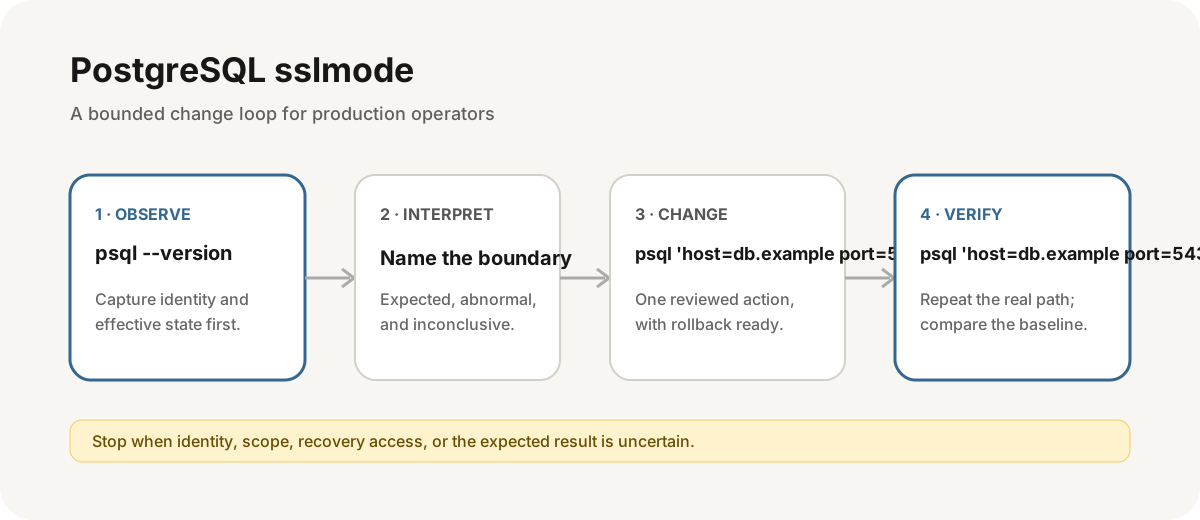
Follow four stages:
- Observe: identify the exact host, object, version, owner, and active configuration.
- Interpret: write the expected result, the abnormal result, and what would remain inconclusive.
- Change: apply one reviewed action at the narrowest layer that contradicts the baseline.
- Verify: repeat the original path and compare the same evidence, including adjacent safety controls.
Preflight and safety boundary
Use a dedicated diagnostic session with timeouts, capture the server version and active workload, and rehearse any blocking or destructive command on a representative copy.
Before PostgreSQL sslmode, record UTC time, the current version or digest, the exact target, recent changes, and who owns the workload. The rollback for this runbook is: restore the previous verified connection string and trust bundle, then rotate endpoints through a staged configuration change.
Do not continue if the target identity is ambiguous, the current state cannot be saved, the only recovery session would be at risk, or the proposed command affects more objects than the brief names.
Capture the read-only baseline
Run these commands one at a time. Replace example names and addresses deliberately; do not paste production secrets into a transcript.
psql --version
psql 'host=db.example port=5432 dbname=app sslmode=verify-full' -XAtc '\\conninfo'
openssl s_client -starttls postgres -connect db.example:5432 -servername db.example </dev/null
Interpret the baseline before moving on:
- Expected: the client reports TLS and verifies the intended hostname against the trusted CA.
- Abnormal: verification fails because the host is an alias, the chain is incomplete, or the trust file is wrong.
- Inconclusive: missing output can also mean the wrong context, permissions, namespace, log window, binary, or target. Prove those assumptions before treating absence as health.
Save the decisive output, exit status, and timestamp. Redact credentials, customer data, private topology, tokens, and complete environment dumps.
Apply the smallest candidate change
The following is state-changing example syntax, not an instruction to run it unchanged:
psql 'host=db.example port=5432 dbname=app sslmode=verify-full sslrootcert=/etc/ssl/certs/db-ca.pem'For PostgreSQL sslmode, the proposed change is acceptable only when the read-only baseline predicts its effect and the rollback is available. The key risk is: switching to disable or require can hide a hostname or trust failure and permit connection to the wrong server.
Prefer an immutable artifact, validated configuration, dry-run, transaction, candidate object, or staged target when the tool supports one. Record the exact command and UTC time so later telemetry can be correlated to the change.
Verify the result from the outside in
psql 'host=db.example port=5432 dbname=app sslmode=verify-full sslrootcert=/etc/ssl/certs/db-ca.pem' -XAtc '\\conninfo'
psql 'host=db.example port=5432 dbname=app sslmode=verify-full sslrootcert=/etc/ssl/certs/db-ca.pem' -XAtc 'select current_user,current_database()'
Verification for PostgreSQL sslmode has three layers:
- The control plane or command reports the intended effective state.
- The process, resource, or data path reflects that state without a new pressure signal.
- The original user-visible or dependent-system path succeeds from an independent vantage point.
If psql 'host=db.example port=5432 dbname=app sslmode=verify-full sslrootcert=/etc/ssl/certs/db-ca.pem' -XAtc '\\conninfo' succeeds but the original path still fails, stop. The change may have repaired a local symptom while DNS, policy, routing, caching, dependency, or client state remains broken.
Failure branches
The baseline does not match this runbook
When verification fails because the host is an alias, the chain is incomplete, or the trust file is wrong, do not force the candidate command. Return to identity and scope, compare a healthy peer only through effective settings, and name a new falsifiable mechanism.
The change succeeds but behavior does not
A successful psql 'host=db.example port=5432 dbname=app sslmode=verify-full sslrootcert=/etc/ssl/certs/db-ca.pem' proves that one interface accepted a request. It does not prove convergence, readiness, data compatibility, external routing, or client recovery. Re-run the same evidence at each downstream boundary.
The change makes the system worse
Execute the written rollback: restore the previous verified connection string and trust bundle, then rotate endpoints through a staged configuration change. Preserve the failed candidate and relevant logs long enough to explain the outcome; do not destroy the evidence with broad cleanup or repeated restarts.
Operator checklist
- Confirm the exact target, context, identity, version, and active owner.
- Capture the read-only baseline and one disconfirming observation.
- Label
psql 'host=db.example port=5432 dbname=app sslmode=verify-full sslrootcert=/etc/ssl/certs/db-ca.pem'as state-changing during review. - Keep recovery access and rollback independent of the path being edited.
- Change one layer, record UTC time, and wait for its real convergence boundary.
- Verify the original path, adjacent controls, resource pressure, and persistence.
- Update the runbook when observed behavior differs from the source-reviewed model.
Investigate it in Tryssh
$ psql 'host=db.example port=5432 dbname=app sslmode=verify-full sslrootcert=/etc/ssl/certs/db-ca.pem' -XAtc '\\conninfo'
Expected: the client reports TLS and verifies the intended hostname against the trusted CA.
Tryssh can preserve this evidence loop and show a state-changing command for human approval. It does not make the operator's identity, recovery access, rollback, or platform authority decisions.
Evidence and review status
This PostgreSQL sslmode runbook was source-reviewed on 2026-07-29 against current first-party documentation. The commands are illustrative and use example targets. The page does not claim that the change was reproduced across every distribution, managed service, version, network, or workload.
Limitations and trade-offs
Switching to disable or require can hide a hostname or trust failure and permit connection to the wrong server. Managed platforms may generate configuration, restrict privileges, replace local state, or expose a different control plane than the upstream project. Confirm the installed version and provider contract before applying a repair.
Search visibility is not proof of operational correctness. Treat this page as a decision aid, preserve independent recovery, and stop when the evidence contradicts its assumptions.
Related operator runbooks
Continue with PostgreSQL replication slots monitoring, pg_dump production backup, the PostgreSQL operations foundation guide, and the SSH hardening checklist.